
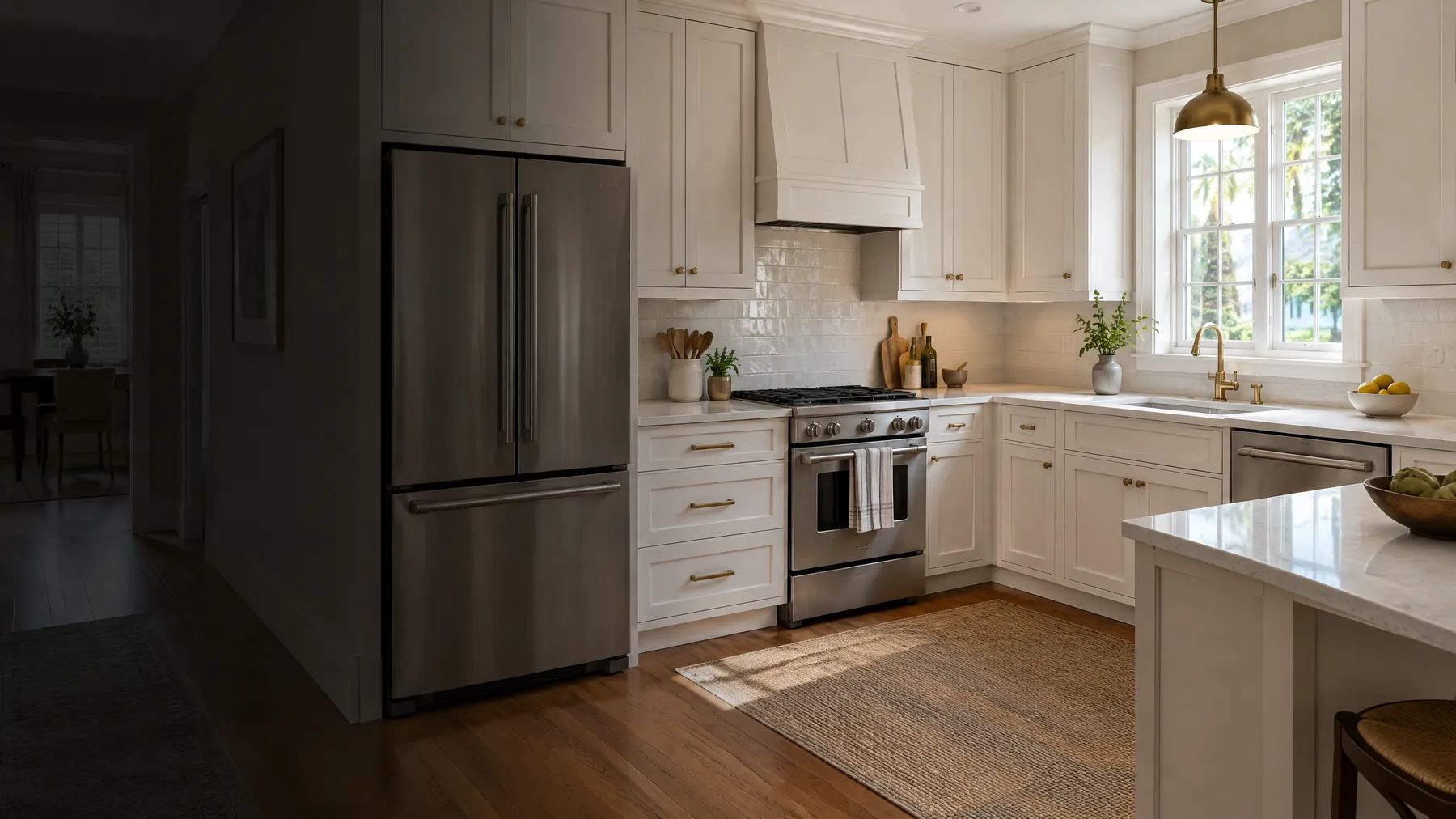
Two of the most common questions we hear about kitchen cabinets are actually the same question asked two different ways: “do I need new cabinets, or can these be saved?” The honest answer depends on your cabinets, not on which service sounds more appealing in an ad. Some kitchens genuinely just need a new look. Others need an entirely new structure — new boxes, a new layout, storage built around how you actually cook — and no amount of new doors will fix that.
DiLeo’s Carpentry LLC builds both: full custom cabinetry, including custom kitchen cabinets built from scratch around your space, and cabinet refacing for kitchens where the existing structure is worth keeping. This guide focuses on that choice as we build it — genuinely custom replacement work rather than a specific brand or price point — though it’s worth knowing that “replacement cabinets” more broadly can also mean stock or semi-custom options from other sources, which follow a different cost and flexibility trade-off than what’s described here. This guide walks through how to tell which path your kitchen actually needs, for homeowners throughout Charleston, Summerville, Mount Pleasant, Moncks Corner, and the surrounding Lowcountry.
What Is Cabinet Refacing?
Cabinet refacing keeps your existing cabinet boxes in place and updates what you see and touch. Depending on what your kitchen needs, that can include new doors, new drawer fronts, hardware changes, and refinishing exposed face frames and end panels — scope that’s assessed and documented for your specific project rather than sold as one fixed package. The layout doesn’t change, because the boxes themselves — and everything about how they’re arranged — stay exactly where they are.
What Does Replacing Cabinets (Full Custom Cabinetry) Actually Involve?
Full cabinet replacement means new cabinet boxes, built for your kitchen’s actual dimensions rather than adapted to an existing structure. This is where genuine custom cabinetry work happens: the layout can change entirely — a different configuration, a new island, a pantry wall where a closet used to be — and every box, drawer, and door is designed around your storage needs rather than fit into whatever’s already there. It’s a bigger project than refacing, but it’s also the only path to a kitchen that actually functions differently than the one you have now.
The Fundamental Difference
Refacing is a cosmetic overhaul of a structure that stays the same. Replacement is a new structure, built for what you actually need. That’s the entire decision in one sentence — everything else in this guide is really just different ways of figuring out which side of that line your kitchen falls on.
When Refacing Makes Sense
Refacing is worth considering when:
- Your cabinet boxes are structurally sound — no water damage, no warping, no separating joints or sagging shelves
- Your current layout genuinely works for how you cook and store things; you’re not constantly working around a bad configuration
- What bothers you is the look — dated doors, worn finish, a color you’re tired of — not the function
- You want a real visual change without the cost and disruption of a full remodel
When Replacing Makes More Sense
Replacement is generally the better investment when:
- Cabinet boxes show water damage, warping, particle board swelling, or other structural issues refacing can’t fix
- Your layout doesn’t work — not enough storage, an awkward workflow between the sink, stove, and fridge, wasted corner space
- You’re changing appliances, adding an island, or reconfiguring the room in a way that requires different box placement
- You want storage built specifically around what you own, not adapted to a generic layout
- You’re already doing other kitchen renovation work — moving plumbing, changing walls — where a new layout makes sense anyway
Key Factors to Weigh
Cabinet Box Condition
This is usually the first real test. Open a few doors and drawers. Do the boxes feel solid, or do you see swelling, delamination, or soft spots, especially near the sink or dishwasher? Sound boxes are a strong argument for refacing. Compromised ones usually mean replacement is the more durable investment, since refacing new doors onto a failing structure just delays the real problem.
Existing Kitchen Layout
If your kitchen’s layout already works — good workflow, enough counter space, storage roughly where you need it — refacing lets you keep what works and update what doesn’t. If you’ve been mentally redesigning your kitchen’s layout for years, refacing alone won’t fix that; a full replacement changes the actual configuration, though a targeted cabinet modification can sometimes resolve a smaller, localized layout problem without a full redesign.
Storage and Functionality Problems
Not liking how your kitchen looks and not being able to find anything in it are two different problems. If storage is the real complaint — not enough of it, or the wrong kind — that’s often a sign you need either a full replacement or, in some cases, targeted storage upgrades within your existing boxes (more on that below).
Desired Style Changes
A different door style, a new paint or stain color, or updated hardware are all changes refacing handles well. A completely different cabinet configuration, new box heights, or a layout that didn’t exist before are changes only replacement can deliver.
Door and Drawer Configuration
Refacing works within your current door and drawer count and placement — you can change how they look, not how many there are or where they sit. Replacement lets you rethink that entirely: more drawers instead of cabinets with shelves, a different door swing, drawer configurations sized around what you actually store. A cabinet modification can sometimes adjust a single opening — resizing for a new appliance, for example — without going as far as a full replacement.
Customization
Refacing offers real customization in finish, hardware, and door style. Replacement offers customization in the structure itself — depth, height, box configuration, and built-in storage features that have to be designed in from the start rather than retrofitted.
Modifications to Existing Cabinetry
Sometimes the issue isn’t the whole kitchen — it’s one section. A new dishwasher that doesn’t fit the old opening, a gap left after removing an appliance, or a section damaged by water can often be addressed through cabinet modifications rather than a full reface or replacement, especially when the rest of the kitchen is working fine.
The Middle Ground: When Targeted Improvements Are Enough
Refacing and full replacement aren’t the only two options, and jumping straight to one or the other can mean overspending or underfixing the actual problem. Some kitchens just need better function inside the boxes they already have: custom cabinet storage solutions like pull-out shelving, roll-out pantry systems, soft-close hinge upgrades, or new custom drawer boxes can solve a real storage complaint without touching the doors or the layout at all. Combined with targeted cabinet modifications for a specific problem area, these upgrades sometimes close the gap between “I don’t love my kitchen” and “I need to replace everything” — worth ruling out before committing to either end of the spectrum.
How Project Scope Affects Cost
Refacing is generally less expensive than full replacement, since the cabinet boxes and layout are reused rather than rebuilt — but scope still matters within each option. A straightforward refacing project with standard doors and hardware costs less than one that adds soft-close upgrades and interior storage improvements throughout. Similarly, a full replacement that keeps your existing footprint costs less than one that adds an island, reconfigures the layout, or adds significant custom storage detailing. Neither option has a single number attached to it — what you choose within either path affects the cost as much as which path you choose in the first place.
Long-Term Considerations
Cost today isn’t the only variable worth weighing. If your layout is genuinely limiting how you use the kitchen, refacing solves the look but leaves the underlying frustration in place — which sometimes means paying for two projects instead of one, a few years apart. On the other hand, if your boxes are solid and your layout works, a full replacement may be more kitchen than the problem actually calls for. How long you plan to stay in the home, whether you’re likely to want a different layout down the road, and whether “good enough for now” tends to bother you over time are all worth factoring in alongside the upfront cost.
Questions to Ask Yourself Before Deciding
- Are my cabinet boxes structurally sound, or do I see water damage, warping, or separating joints?
- Does my current layout actually work for how I cook and store things, or am I working around it?
- Am I unhappy with the look, the function, or both?
- Am I planning other kitchen changes — new appliances, an island, moved plumbing — that would require a new layout anyway?
- How long do I plan to stay in this home?
- Would better storage inside my existing cabinets solve most of what bothers me?
If you can answer most of these clearly, you likely already know which direction fits. If you’re not sure, that’s exactly what an in-person estimate is for — we’ll look at your actual cabinets and give you an honest read on which option fits, not just the one that’s easier to sell.
Frequently Asked Questions
How do I know if my cabinet boxes are still in good shape?
Check for water damage or swelling near the sink and dishwasher, feel for soft or delaminating spots on the interior panels, and check that doors and drawers still operate smoothly without sagging. Boxes that pass these checks are generally good candidates for refacing.
Is refacing always cheaper than replacing?
Generally, yes, since the boxes and layout are reused rather than rebuilt. But a heavily upgraded refacing project can cost more than a very simple, small-scope replacement, so it’s worth getting both assessed rather than assuming one is automatically cheaper for your specific kitchen.
Can I change my kitchen layout with refacing?
Refacing itself works within your existing layout — it won’t reconfigure the room. Full custom kitchen cabinets is the option built for a genuinely different configuration, more storage, or a new island. For a smaller, localized layout issue, a cabinet modification or storage upgrade can sometimes help without a full replacement — worth mentioning during your estimate if that’s closer to what you’re dealing with.
What if only some of my cabinets have a problem?
That’s often a case for cabinet modifications rather than refacing or replacing the whole kitchen — we can address a specific section while leaving the rest of your cabinets untouched.
Does refacing look as good as new cabinets?
Done well, refacing can look genuinely new, since new doors, drawer fronts, and finish are what your eye mostly registers. It won’t change the underlying box construction or layout, which is the trade-off for the lower cost and disruption.
Can I improve my storage without a full replacement?
Often, yes. Custom cabinet storage solutions — pull-out shelving, roll-out pantry systems, custom drawer boxes — can solve a real functionality complaint inside your existing cabinet boxes.
Should I just get both options priced out?
That’s often the most useful approach if you’re genuinely unsure. Seeing both estimates side by side, based on your actual cabinets, makes the decision a lot clearer than trying to guess in the abstract.
8. Comparison Table: Cabinet Refacing vs. Full Cabinet Replacement / Custom Cabinetry
| Factor | Cabinet Refacing | Full Replacement / Custom Cabinetry |
| Existing cabinet boxes | Kept and reused | Entirely new, built for your space |
| Layout flexibility | Layout stays as-is (though a targeted modification can sometimes adjust a single opening) | Full flexibility to redesign the layout |
| Design flexibility | New doors, drawer fronts, and finish | Complete design freedom — style, configuration, and materials |
| Storage customization | Limited to what fits within existing boxes | Built around your exact storage needs from the start |
| Project scope | Cosmetic — doors, fronts, hardware, and box refinishing where included in the scope | Structural — new cabinet boxes, potentially a new layout |
| Relative cost | Generally lower, since boxes and layout are reused | Generally higher, reflecting a full custom build |
| Best use case | Solid boxes, workable layout, want a new look | Damaged boxes, poor layout, or a need for different storage |
 Veteran-Owned
 5-Star Rated
 24hr Response